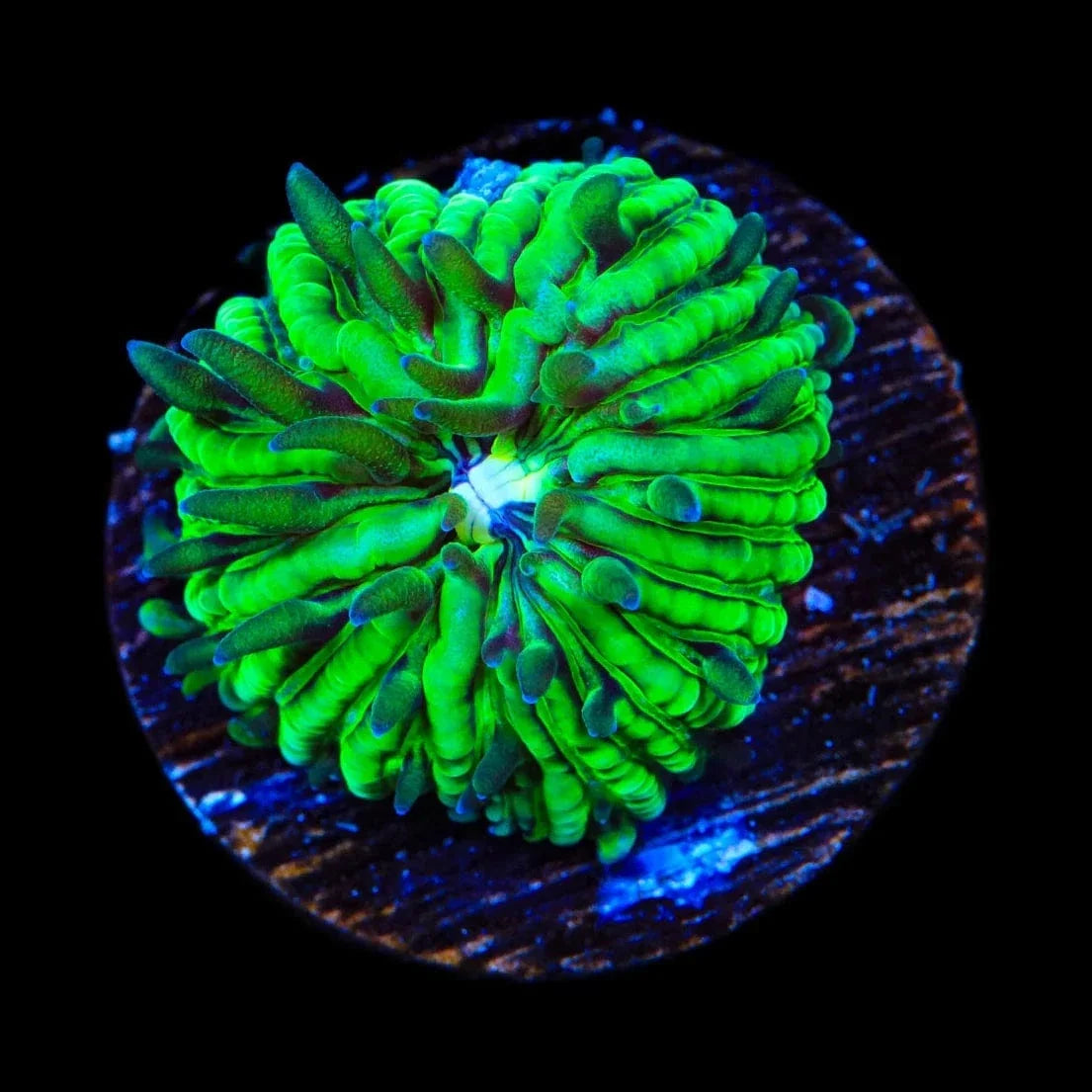
TSA Funky Fungia Plate Coral
TSA Funky Fungia Plate Coral
You will receive a frag SIMILAR in shape and size to the coral in the photo. This is NOT a WYSIWYG frag.
Fungia Plate Coral
Fungia plate coral is a large polyp stony (LPS) coral in the family Fungiidae, easy to recognize by its round, flat or slightly domed disc and the fine ridges (septa) that radiate out from a central mouth. Unlike most stony corals, a mature plate coral is free-living: instead of cementing itself to the reef, it rests loose on the substrate. Short tentacles extend across the disc, softening its look, and colors range from green and tan to pink, orange, and purple.
The name fungia coral is widely used in the hobby for several closely related plate corals, some of which taxonomists have since moved into other genera. The long tentacle plate coral (Heliofungia) is a related but more delicate coral with much longer tentacles. For most reefers with a sand bed and stable water, a plate coral is a rewarding, low-maintenance LPS.
Plate Coral Care at a Glance
| Parameter | Recommended Range |
|---|---|
| Care level | Easy to moderate |
| Lighting | Moderate |
| Water flow | Low to moderate |
| Placement | Flat area of the sand bed |
| Temperament | Can sting nearby corals; give it space |
| Temperature | 75–80°F |
| Salinity | 1.025–1.026 |
| pH | 8.1–8.4 |
| Calcium | 420–440 ppm |
| Alkalinity | 8–9.5 dKH |
| Magnesium | 1300–1450 ppm |
| Nitrate | <10 ppm |
| Phosphate | <0.10 ppm |
| Origin | Indo-Pacific |
Water Chemistry
The water conditions above come from our hard coral quick guide. Plate corals build a stony skeleton, so steady calcium, alkalinity, and magnesium support healthy growth. Keep parameters stable and make small corrections rather than large ones.
Lighting
Moderate lighting suits most plate corals. Too much intensity can cause the tissue to shrink back or bleach, while too little can leave the coral looking deflated over time. Introduce a new coral at moderate light and watch how fully it extends before making changes.
Water Flow
Low to moderate, indirect flow is best. Enough movement keeps detritus from settling on the disc, but strong flow can prevent the coral from extending fully and can even push or flip it across the sand.
Placement
Because plate corals are free-living as they mature, most reefers keep them on a flat area of the sand bed rather than up on the rockwork, where they can slide off and tear their tissue on rock. Plate corals can slowly shift position, and their tentacles can sting other corals, so leave open space around them.
What We Feed
Plate corals get much of their energy from photosynthesis, but they also catch food with their tentacles and benefit from regular feeding. We recommend broadcast feeding a mixture of zooplankton, phytoplankton, amino acids, and other organic proteins with pumps off, so the coral can capture what it needs. Many reefers also offer small meaty foods directly onto the tentacles. Our recommended feeds:
Corals grown in our aquaculture facility are lit by EcoTech Marine Radion XR30s and powered by a mix of EcoTech Marine Vortech pumps and Sicce wavemakers.
Coloration and Settling In
Plate coral color depends on lighting, nutrition, and water stability. After shipping, it is common for a plate coral to stay retracted for several days. Once it settles in, the tissue and tentacles should extend more fully across the disc.
Common Plate Coral Challenges
- Tissue damage: usually from falling off rockwork or resting against sharp rock; keep it on the sand
- Flipped or buried corals: strong flow and sand-sifting tankmates can overturn or cover the disc; check it daily at first
- Stinging neighbors: tentacles can reach nearby corals, so give it room
- Shrinking or bleaching: often caused by sudden changes in light or unstable parameters
- Nibbling fish: some angelfish and butterflyfish may pick at LPS tissue
How to Acclimate a Plate Coral
- Temperature: float the sealed bag in your aquarium to equalize temperature.
- Water: slowly add your tank water to the bag so the coral can adjust to your parameters.
- Placement: set the coral on a flat, open area of the sand bed with moderate light and gentle flow.
- Observation: give it several days to extend before moving it.
Share
Couldn't load pickup availability